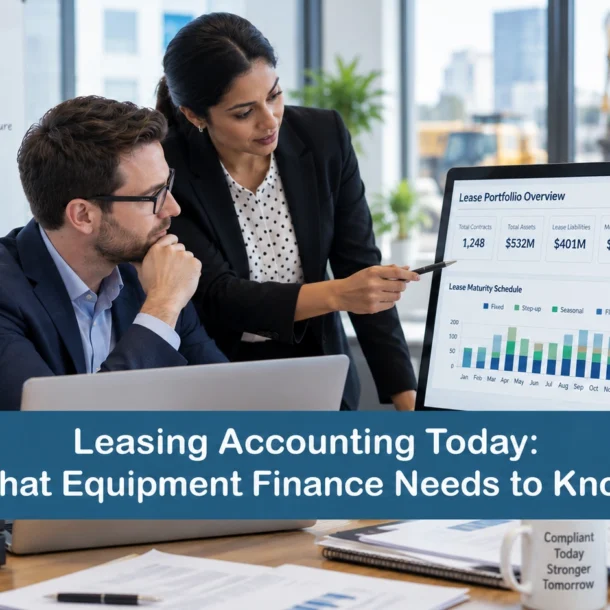


Managing an equipment lease portfolio with disconnected spreadsheets creates severe structural vulnerabilities that can compromise financial integrity, operational efficiency, scalability, and long-term business value. While spreadsheets remain a familiar entry point for commercial finance organizations because they require little initial investment, offer flexibility, and are widely understood by finance teams, their limitation become increasingly apparent as contract volumes and portfolio complexity grow.
Every phase of the environment lease accounting lifecycle requires precision. This includes capturing the initial contract term, configuring custom payment structures, applying variable interest rates, tracking asset value, processing billing and in-life adjustments.
Modifications, and generating accurate general ledger journal entries. When these activities are managed across multiple disconnected workbooks, the organization becomes increasingly dependent on manual processes and individual user knowledge. The result is not simply an inconvenience; it creates systemic operational risk.
Manual data entry can introduce transcription errors, while broken formulas, incorrect cell references, missed links, and circular calculations can quietly compromise amortization schedules across an entire portfolio. These errors may not immediately trigger a warning or system alert, allowing inaccurate information to flow through subsequent processes.
Version control is another significant challenge. As different members of the finance team update and save individual workbooks, organizations can quickly end up with multiple versions of the same portfolio data. One employee may be working from an updated schedule while another is using an older version. Without centralized controls, it becomes difficult to determine which file represents the official record.
As contract volumes increase, the problem compounds. What may initially be manageable for a small portfolio can become extremely difficult to control when you must maintain hundreds or thousands of contracts, assets, payment schedules, and modifications.
Equipment lease accounting is rarely limited to simple fixed monthly payments. Commercial equipment finance portfolios can include non-standard payment structures such as step-up payments, seasonal payments, skipped payments, payment deferrals, floating interest rates, residual values, and customized contractual terms.
When these variables are manually configured within spreadsheet cells, even a small calculation error can have a significant downstream impact. An incorrect interest rate, payment date, or formula reference can affect interest income recognition, outstanding balances, asset valuation, and subsequent accounting entries.
Because spreadsheets generally rely on users to identify and correct these issues, errors can remain hidden for extended periods. A problem introduced when a contract is originally entered may not become apparent until a reconciliation, audit, contract modification, or portfolio review occurs. Incorrect accounting information can lead to additional investigation, delayed reporting, audit concerns, strained internal controls, and reduced confidence in portfolio data.
Equipment lease contracts are rarely static throughout their entire lifecycle. Customers may request equipment upgrades, partial asset returns, lease extensions, payment deferrals, restructuring, or early buyouts.
A mid-term modification often requires multiple accounting changes. Remaining balances may need to be recalculated, payment schedules may need to be re-amortized, interest calculations may need to be updated, and new journal entries may need to be generated.
In a spreadsheet-centric environment, these adjustments frequently require accounting personnel to modify existing formulas or create secondary schedules connected to the original workbook. Once an original formula or schedule has been overwritten, it is difficult to determine what changed, when and why the change was required, and who made the modification.
A connected lease accounting platform can instead maintain the contract lifecycle within a controlled system, providing greater consistency and traceability as contractual terms change.
The administrative burden of spreadsheet-based lease accounting becomes especially visible during month-end and quarter-end closing.
Equipment finance businesses receive payments through multiple channels, including Automated Clearing House transfers, wire payments, and checks. These payments must be matched against individual contracts and billing schedules. When schedules are maintained in separate spreadsheets, accounting personnel may need to perform line-by-line verification to determine whether each payment matches the expected amount and accounting allocation.
They may also need to account for differences caused by taxes, late fees, short payments, payment timing, or other contractual adjustments.
Instead of focusing on analysis and strategic decisions, finance professionals spend significant time finding discrepancies and correcting spreadsheet data.
One of the most important disadvantages of disconnected spreadsheets is the lack of real-time portfolio visibility. Equipment finance leaders need timely answers to questions about cash flow, asset performance, contract status, outstanding balances, payment activity, and overall portfolio risk.
Management may struggle to determine which asset classes are performing well, where payment issues are increasing, how modifications are affecting portfolio performance, or where operational bottlenecks are developing. Connected systems provide a different operating model by bringing contract, billing, accounting, payment, and reporting information together within a centralized environment.
Spreadsheet-based accounting also introduces governance and security risks.
There is a key-person dependency. In many organizations, a senior accountant or financial analyst becomes the primary person responsible for designing and maintaining complex spreadsheet models. If that employee leaves the organization, the company may inherit complex workbooks that are difficult to understand or maintain.
As an equipment finance company grows, operational efficiency becomes increasingly important. Adding more contracts should not require adding a proportional number of spreadsheets, reconciliations, schedules, and accounting entries.
However, spreadsheet-based processes often scale poorly because manual activities increase as portfolio volume increases.
Technology-enabled finance organizations can take a different approach. Automated workflows allow organizations to process increasing contract volumes while maintaining consistent processes and controls, creating a stronger foundation for scalable growth.
A centralized system also improves traceability for complex adjustments, billing activity, accounting transactions, and other important lifecycle events, which are better managed through controlled processes. This creates a clearer history of how portfolio information changes over time.
For auditors and management, it provides greater confidence that portfolio information is maintained consistently and can be traced back to the underlying transaction or contract activity.
The competitive landscape of commercial equipment finance demands speed, accuracy, and operational discipline. When back-office teams are burdened with manual data entry, spreadsheet maintenance, billing preparation, and reconciliation, deal velocity can slow down. Delays in document processing, payment servicing, accounting, and reporting can ultimately affect customer experience and portfolio growth.
By contrast, organizations that adopt automated lease accounting platforms can transform finance operations from an administrative bottleneck into a strategic capability. Automated platforms can centralize contract information, generate amortization schedules, support billing processes, create accounting entries, and provide management reporting from a connected system.
Spreadsheets have played an important role in the development of commercial finance operations. Their flexibility, accessibility, and low initial cost made them an attractive solution for organizations managing smaller portfolios. However, as equipment lease portfolios become larger and more complex, spreadsheets become increasingly difficult to control.
The hidden costs include manual errors, broken formulas, version-control problems, limited audit visibility, reconciliation bottlenecks, key-person dependency, security concerns, and reduced management visibility.
Transitioning to dedicated, automated lease accounting technology provides a stronger foundation for modern equipment finance operations. By connecting contract management, amortization, billing, accounting, payments, and reporting, organizations can reduce operational friction while improving data integrity, traceability, and visibility.
For equipment lessors focused on sustainable, risk-controlled growth, moving away from disconnected spreadsheets is more than a routine software decision. It is a foundational step toward building a connected, resilient, scalable, and enterprise-ready finance operation.
Athena Fintech provides the opportunity to make that transition by replacing fragmented spreadsheet processes with a connected lease accounting environment designed to support the complete equipment lease lifecycle and help finance teams operate with greater accuracy, visibility, and control.

Reach our dedicated support team
at info@athenafintech.com or +1 650 701 7703.
Questions or assistance?
We’ve got you covered.
Athena Fintech Inc.
HQ: California, USA
Tech Center: India
Athena Fintech Inc.
HQ: California, USA
Tech Center: India