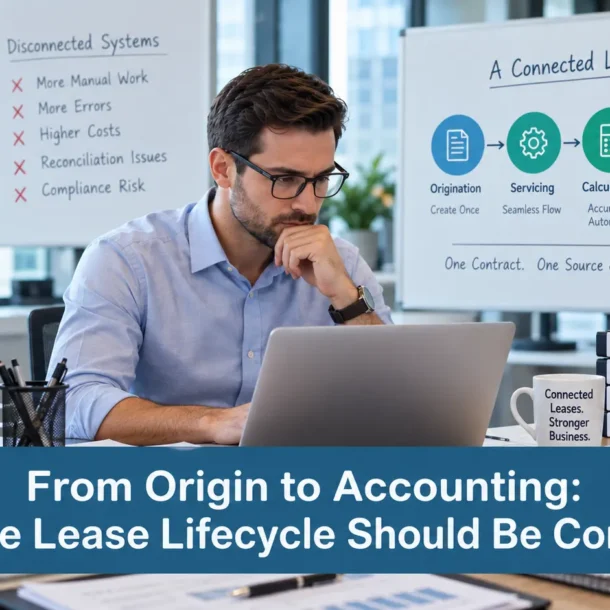


Leasing accounting has entered a new phase. For equipment finance companies, the conversation is no longer about how to implement ASC 842; it is about how to optimize, automate, and scale compliance while managing increasingly complex portfolios, new asset classes, and heightened audit expectations.
From EV fleet and data storage to AI infrastructure, medical devices, and construction equipment, being financed has evolved dramatically, and audit standards have tightened, with investor demand for real-time transparency and regulators expecting robust controls. this environment, it is about transforming lease accounting from a back-office compliance burden into the strategic enabler of growth, portfolio, and valuation.
Most equipment finance companies completed their initial ASC 842 adoption several years ago. Today, auditors are no longer assisting with implementation; they are testing for operational effectiveness, completeness, and control maturity using AI-driven tools that scan the entire lease population for anomalies, trends, and classification inconsistencies across thousands of contracts simultaneously.
Their focus has shifted to three critical areas: population, completeness, and classification accuracy and control environment; these three pillars now define audit readiness for equipment finance lessors regardless of portfolio size.
Population completeness asks: can you prove your lease population is complete contracts are missing from your subledgers? Can you reconcile your origination system to your accounting system without manual spreadsheet emails and disconnected workbooks? Can you demonstrate systematic linkage from executed contract to billing to general ledger?
Classification accuracy asks: Can you support your lease classification judgment under ASC 840-10-25 weather contract is sales-type or direct financing, or operating, with documented assumptions for fair value and economic life, purchase options, and residual value? Are fair value determinations supportable and consistent?
Control environment asks: Can you demonstrate segregation of duties and approval workflow and an immutable audit for every change to the contract? Can you change what, when, and why, and who approved it? Can you produce evidence that your disconnect rates and residual assumptions were reviewed and approved?
Firms relying on disconnected spreadsheets and manual work struggle to answer these questions. When a cell is overwritten, the original value is lost forever. When multiple versions exist across shared drives and email attachments, completeness can’t be asserted. There is no automated approval, no validation logic, and no lineage. There is no systematic enforcement of accounting policy.
Commercial equipment finance portfolios rarely involve simple fixed monthly payments. Modern lease structures are inherently complex and reflect the diverse needs of lessees, changing asset types, and evolving market conditions.
Common complexities include step-up and step-down payments that increase or decrease over time to match lessee cash flow, seasonal payment structures for agriculture, construction, and transportation where cash flows are uneven and cyclical, skipped payments and deferral programs offered during economic stress or customer hardship, floating interest rates tied to SOFR with periodic resets and floors, customized residual values and residual value guarantees that impact classification and profit, and bundled contracts that include maintenance, software, services, consumables, and usage-based charges.
Under ASC 842-10-15, lessors must identify and separate lease and non-lease components and allocate consideration on a relative standalone price basis. An incorrect allocation overstates lease revenue and understates service revenue, creating GAAP errors, misstated margins, tax issues, and management reporting distortion that compounds over time.
An incorrect residual assumption can misclassify a sales-type lease as an operating lease, shifting profit recognition from upfront to over time and violating GAAP timing and disclosure requirements. An incorrect SOFR adjustment can misstate interest income recognition for an entire quarter and distort yield analysis, pricing decisions, and portfolio profitability.
As portfolios expand to include electric vehicle fleets with battery health clauses and government incentives, medical equipment with usage-based billing and service level agreements, and IT assets with embedded software subscriptions and renewal options, manual spreadsheet calculations become statistically certain to fail and increasingly expensive to maintain.
Lease contracts are dynamic assets, not static amortization schedules. Over a multi-year term, lessees frequently request upgrades, partial asset returns, extensions, deferrals, restructures, payment holidays, or early buyout options to align with their own business cycles, technology refresh cycles, and budget constraints.
Under ASC 842, each modification requires a structured accounting assessment that must be documented for audit; first, determine if the modification creates a separate new lease under ASC 842-10-25-8. If it does not qualify as a separate lease, you must recalculate the net investment in the lease, remeasure the lease receivable using a revised discount rate that reflects current market conditions, adjust the unguaranteed residual asset, and recognize any gain or loss under ASC 842-10-25-14 and related guidance.
In spreadsheet environments, accounting teams often overwrite original amortization schedules or build secondary linked tabs and manual journal entries to true up interest income and billing. Once overwritten, the before-and-after lineage is lost. There is no automated record of what changed, why it changed, when it occurred, or who approved it.
This creates three critical risks that directly impact financial integrity and scalability. First, operational inefficiency as senior accountants manually rebuild amortization schedules for each modification. Second, control failure as undocumented changes bypass segregation of duties. Third, audit failure, as the company cannot produce evidence for the modification treatment.
Best-in-class lessors today treat modifications as structured events within a controlled platform — with automated remeasurement, dual approvals, full history preservation, and systematic generation of new journal entries and billing schedules.
Manual lease accounting creates operational bottlenecks that directly impact cash flow, customer experience, portfolio growth, and ability to scale efficiently.
Month-End Close Delays: Matching incoming ACH, wire, and check payments against billing schedules requires tedious verification to resolve variances from sales tax, property tax, late fees, short payments, overpayments, and timing differences. Teams spend days hunting broken VLOOKUPs instead of analyzing profitability, resulting in unapplied cash and delayed income recognition.
Lack of Real-Time Visibility: When contract terms and accounting entries live in disconnected workbooks, leadership cannot quickly assess future cash flows, asset performance, delinquency trends, or residual risk exposure. Decisions are made on obsolete data. Investors demand real-time dashboards.
The spreadsheet guru who created the macros. If that person leaves, the company inherits brittle workbooks with broken macros, creating a single point of failure. Key-Person Dependency: Complex models are often built by a single employee.
Disclosure Complexity: Today, lessors must also track electrification incentives, energy tax credits, and ESG-related reporting. They must produce quantitative disclosures required by ASC 842.
Leading equipment finance companies are transforming lease accounting from a back-office compliance task into a strategic growth enabler.
Centralize Portfolio Data: Maintain contract terms, amortization schedules, billing triggers, and accounting entries within a single source of truth with role-based access and version control.
Enforce Data Integrity and Auditability: Utilize automated workflows and immutable audit logs. Every decision is documented with an approver and timestamp, ensuring continuous audit readiness and reducing external audit fees by up to 40 percent.
Accelerate Financial Close: Automate general ledger entry generation mapped to NetSuite, SAP, Oracle, and Sage Intacct, connect to bank feeds for automated cash application, and post entries daily. Firms that automate close 60 percent faster and 90 percent fewer manual journal entries.
Empower Finance Teams: Shift skilled accountants away from spreadsheet maintenance toward high-value analysis — portfolio yield optimization, residual risk management, pricing strategy, and customer profitability.

Reach our dedicated support team
at info@athenafintech.com or +1 650 701 7703.
Questions or assistance?
We’ve got you covered.

Athena Fintech Inc.
HQ: California, USA
Tech Center: India
Athena Fintech Inc.
HQ: California, USA
Tech Center: India