
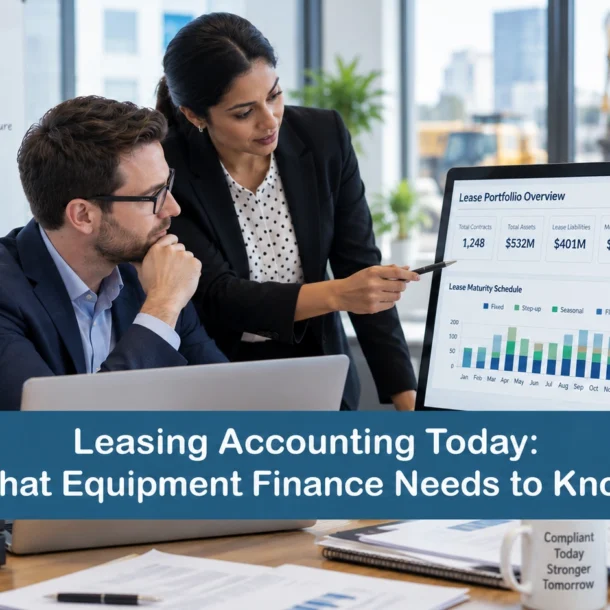

For many equipment finance companies, banks, captives, and independent lessors, the lease lifecycle is managed in pieces. Origination lives in a CRM or loan origination system. Credit and pricing live in spreadsheets. Servicing runs in a separate operations platform. Calculations are rebuilt manually. Reporting is pulled from multiple sources. And accounting closes the books in an ERP that never quite matches the servicing system.
On paper, each system works. In practice, the gaps between them create the biggest risks, costs, and delays in your business. Every handoff is a chance for error, delay, and reconciliation.
A connected lease lifecycle, where origination, servicing, calculations, reporting, and accounting share a single source of truth, is not just an IT upgrade. It is how high-performing lessors scale profitably, satisfy auditors, and stay fully compliant with ASC 842, IFRS 16, and complex tax rules.
Here is why connection matters and why leading lessors are moving away from siloed systems.
When each stage of a lease lives in a separate system, you must re-enter, reconcile, and re-validate the same deal over and over again.
Consider a typical deal: An originator structures a lease with a two-month deferral, a step-up payment schedule, and a residual. That structure is entered in the origination system, then re-keyed into servicing. Finance then rebuilds the amortization schedule in Excel to calculate interest income, fees, and revenue recognition. At month-end, accounting tries to match servicing balances to the general ledger and finds they do not tie.
This is the reality of siloed systems:
Data duplication and error: Every manual handoff is an opportunity for a typo that becomes a financial misstatement. A wrong residual, rate, or date can cascade across accounting and reporting.
Slow cycle times: Booking a complex lease can take hours or days because teams are waiting on each other to confirm numbers. Funding is delayed, and customer experience suffers.
Reconciliation chaos: Month-end close becomes a forensic exercise instead of a routine process. Teams spend days explaining variances between servicing and accounting rather than analyzing performance.
Compliance risk: Under ASC 842 and IFRS 16, you must prove how every number was calculated, classified, and remeasured. If your calculation lives in a disconnected spreadsheet, you cannot provide a complete audit trail.
In a connected model, a lease is created once and flows seamlessly through every stage with full integrity and auditability.
Origination to Servicing: Once a deal is approved, all commercial terms, parties, collateral, pricing, documentation, and conditions flow directly into servicing. No re-keying. The contract that was sold is exactly the contract that gets serviced and accounted for.
Servicing to Calculations: Payment schedules, interest accruals, fees, residuals, early termination quotes, restructures, and impairments are calculated by the same certified engine that services the contract. If a customer restructures mid-term, the system instantly recalculates the new schedule, net present value, and accounting impacts with proper catch-up accounting.
Calculations to Accounting: Every servicing event automatically creates a balanced, double-entry accounting event. Billings, cash application, accruals, deferrals, charge-offs, recoveries, and foreign exchange revaluations post to the sub-ledger in real time, ready to be posted to your ERP, no manual journals for standard activity.
Accounting to Reporting: Because origination, servicing, and accounting share the same data, reporting is no longer a reconciliation exercise. Portfolio performance, yield, delinquency, maturity, concentration, and compliance reports are always in sync. Finance, risk, and operations look at the same numbers.
When you connect the lifecycle, you eliminate the question: Which system is right?
The origination asset value is the servicing asset value. The servicing payment schedule is the accounting amortization schedule. Changes made in one place propagate everywhere with full audit history, effective dating, and user controls.
This dramatically reduces operational risk, improves data quality, and gives auditors exactly what they need: a clear lineage from quote to cash to general ledger. You can trace any GL balance back to the contract, event, and calculation that created it.
Disconnected processes require people to act as the integration layer. Connected platforms automate the handoffs.
Origination can fund and activate in minutes, not days. Customer service can generate a legally compliant payoff quote without calling finance to recalculate it. Collections sees the same accurate balance as accounting and can take action immediately.
For lessors we work with, this typically cuts booking time by sixty to seventy percent and reduces manual journal entries at month-end by over eighty percent. Your team stops chasing data and starts managing the portfolio, improving customer satisfaction and freeing capacity for growth without adding headcount.
Lease accounting standards require precise, auditable calculations for classification tests, right-of-use assets, lease liabilities, interest and depreciation separation, and remeasurement on modification.
If calculations are done outside your core system, compliance is fragile. A single formula error in a spreadsheet can affect hundreds of contracts and create a material weakness.
A connected lifecycle uses a single, certified calculation engine for both operational servicing and financial accounting. It automatically handles ninety percent of other classification tests at inception, effective interest rate and actuarial calculations, accurate revenue recognition for sales-type, direct financing, and operating leases, automatic remeasurement and catch-up accounting for modifications, impairments, and terminations, and full sub-ledger to general ledger traceability for internal and external auditors. Tax books, including federal and state income tax and sales and use tax, are calculated consistently.
You close faster, with confidence that your books reflect your contracts and that you can prove it.
When systems are siloed, management reporting is always looking in the rearview mirror. By the time you consolidate data from five systems, it is two weeks old and already outdated.
A connected lifecycle gives you real-time portfolio insight. You can see how origination pricing decisions are impacting actual yield and return on assets. You can forecast cash flow based on live contract performance, not last month’s extract. You can identify at-risk segments, concentrations, and profitability trends before they become losses.
This visibility connects front office and back office around profitability, not just volume. Leadership can make informed decisions on pricing, residual setting, and market strategy because origination, risk, and finance share the same foundation.
Your customer does not care about your internal systems. They just want a fast answer, an accurate statement, and a flexible partner when their business needs change.
When your team has a unified view of the contract, they can answer questions on the first call. They can model a restructuring option while the customer is on the phone and show the impact immediately. Self-service portals can show accurate, real-time information because they pull from the same source as accounting, reducing inbound calls.
And when you are ready to grow, adding new products, new asset classes, new channels, or higher volume, you scale without adding headcount to manage reconciliations. The platform scales with you. New lease types, payment structures, and accounting policies can be configured, not custom coded, accelerating time to market.
Many lessors attempt to solve disconnection by building integrations between siloed systems. While this is better than manual re-entry, point-to-point integrations are brittle, expensive to maintain, and still leave you with multiple calculation engines and data stores.
A truly connected lifecycle is different. It is built on a single domain model for leases, a single calculation engine, and a single event-based accounting sub-ledger. Integration becomes orchestration, not replication. Upgrades are simpler, data quality is higher, and innovation is faster.
The result is a platform that supports the entire journey from first inquiry to final disposition, providing consistency, control, and confidence at every step.
The equipment finance market is moving toward more complex structures, more demanding compliance requirements, and higher expectations for speed and transparency. Managing origination, servicing, calculations, reporting, and accounting in separate systems was acceptable when volume was low, and standards were simpler. Today, it is a clear competitive disadvantage that increases cost and risk.
A connected lease lifecycle reduces risk, lowers cost to serve, accelerates financial close, and gives you the accurate, auditable data you need to grow profitably. It transforms your lease management system from a set of disconnected tools into a strategic asset that connects every team from the first quote to the final accounting entry.
If your month-end still involves spreadsheets, late nights, reconciliation meetings, and debating which system is correct, it is time to connect the lifecycle and build a foundation for scalable growth. Start your transformation journey today.
From a set of disconnected tools into a strategic asset that connects every team from the first quote to the final accounting entry.
Embracing connectivity empowers lessors to reduce costs, strengthen controls, improve audit readiness, accelerate innovation, and deliver consistent experiences that drive retention, competitive differentiation, and long-term sustainable success across global markets today.
Spreadsheets, late nights, reconciliation meetings, and debating which system is correct- it is time to connect the lifecycle and build a foundation for scalable growth. Start your transformation journey today.

Reach our dedicated support team
at info@athenafintech.com or +1 650 701 7703.
Questions or assistance?
We’ve got you covered.
Athena Fintech Inc.
HQ: California, USA
Tech Center: India
Athena Fintech Inc.
HQ: California, USA
Tech Center: India