

Lease accounting for lessors looks simple: book the lease, collect rent, recognize income. Under ASC 842 and IFRS 16, it is anything but simple.
For lessees, the standards brought leases onto the balance sheet. For lessors, the model stayed- operating, sales-type, direct financing- but added judgment and complexity around modifications, estimates, and profit recognition.
We see the same five mistakes in audits, restatements, and month-end closes. Small at origination, they compound into thousands of hours and millions of dollars.
Here are the five costliest mistakes and how to avoid them.
This guide breaks down each mistake with real-world audit impacts and practical fixes. Whether you manage equipment, vehicles, or real estate leases, these insights will help you avoid restatements, accelerate close, and build a more defensible, scalable lessor accounting process for modern lessors operating in regulatory environments today.
The Mistake
Treating every lease as operating, or automatically treating any bargain purchase option as sales-type, without performing the full ASC 842 test.
Many systems default to operating because it is easier. Sales prefers operating because it keeps the asset on the books. But classification isn’t a choice—it is a five-part test.
A lease is sales-type if it meets ANY criteria:
Transfer of ownership at end of term
Purchase option reasonably certain to be exercised
Lease term is major part of remaining economic life
Present value of payments equals or exceeds substantially all of fair value
Asset is specialized with no alternative use
If it fails sales-type but PV of payments plus residual guarantee equals all of fair value substantially, and collectability is probable, it is direct financing. Otherwise, operating.
The Cost
Misclassification is the number one cause of lessor restatements. Booking sales-type as operating defers Day 1 profit, overstates assets, and understates revenue. Booking operating as sales-type accelerates profit you never earned.
Lessors have restated three years because their “major part” threshold was 75 percent in Excel, but auditors required 70 percent for certain assets. Under IFRS 16, there is no direct financing category, so errors directly misstate revenue.
How to Fix It
Automate classification at origination. Your quoting tool should run the full ASC 842 and IFRS 16 test using fair value, economic life, discount rate, and reasonably certain options.
Document judgment for borderline cases, for example, 68 percent of life, and store it with the lease, not in email. Never allow classification as a manual dropdown.
The Mistake
Using the lessee’s incremental borrowing rate, corporate WACC, or stale rate to calculate lessor receivable.
For lessors, ASC 842 is explicit: use the rate implicit in the lease whenever determinable. This is the rate where PV of payments plus unguaranteed residual equals fair value plus initial direct costs.
Teams get this wrong because the implicit rate requires a residual assumption at inception, which sales may not share. So accounting backs into a rate.
The Cost
Rate drives everything: net investment size, interest income, and whether lease passes 90 percent fair value test.
A 50 basis point error on a 10 million dollar, five-year portfolio can misstate interest by 150,000 dollars. Worse, sales-type profit is wrong. Day 1 profit equals fair value minus carrying amount minus uncapitalized IDC. If the investment is wrong due to the rate, profit and balance sheet are wrong.
How to Fix It
Solve for implicit rate at origination, not at month-end. The system should auto-solve when you input asset cost, fair value, payment schedule, residual, and IDC.
If implicit rate is negative or not determinable, document why and fallback. Store rate curve, inputs, and solver result as immutable audit record. Reuse same rate for remeasurement.
The Mistake
Capitalizing everything — commissions, marketing, credit checks, legal for failed deals, overhead — as Initial Direct Costs.
Under ASC 842-10-30-9, lessor IDC are ONLY costs that would not have been incurred if the lease had not been obtained and are directly attributable to negotiating it.
What qualifies: Commissions paid as a direct result of obtaining that specific lease, legal fees directly tied to that lease.
What does NOT qualify: Advertising, marketing, prospect evaluation, legal for failed leases, overhead supervision, credit department, servicing.
Lessors often capitalize entire origination cost center, inflating investment and deferring expense.
The Cost
You overstate assets and understate expenses — audit failure. For sales-type leases, ineligible IDC reduces Day 1 selling profit because costs are deducted from fair value. Then you amortize them into interest, distorting yield. At early termination, you write off large IDC that should never have existed.
For operating leases, ineligible IDC amortized straight-line inflates assets and mismatches expense.
How to Fix It
Enforce a strict IDC policy in the system. Create two buckets: “Eligible IDC” with documentation and “Deal Costs – Expense Immediately.”
Only Eligible costs linked to a signed lease flow to accounting. Integrate the commission system so commission capitalizes only when the lease is booked, not quoted. For operating leases, lessor IDC is still capitalized, but only if it truly qualifies.
The Mistake
Treating every change, deferral, extension, asset addition, or rate change as a new lease, or ignoring it and billing the old schedule.
Modifications are the most complex area. Under ASC 842-10-25, first ask: Is this a separate new lease? If not, how to remeasure?
Rules:
If the modification grants additional right-of-use not in the original and the price is commensurate with the standalone price, it is a separate new lease.
If not, it is a modification. For sales-type or direct financing, determine if it would have been classified differently at inception with modified terms. If yes, new lease. If no, remeasure net investment using new discount rate at modification date.
For operating, account as a new lease from the modification date, considering prepaid or accrued rents.
Most fail because operations handles modification in the servicing system but never tells accounting.
The Cost
Compliance and revenue leakage disaster. If you do not remeasure, receivable and interest are wrong. If you treat modification as a new lease when it should be remeasurement, you recognize second Day 1 profit and double-count the asset.
If you ignore a concession not in the original contract, you overstate receivable. During COVID-19, many granted deferrals but continued accruing interest on the original schedule, creating massive audit adjustments.
How to Fix It
Use a single event-driven lifecycle. Any change — extension, payment change, substitution, termination — must be a structured lifecycle event that auto-triggers ASC 842 analysis: separate lease, new classification, new rate?
System should calculate remeasurement, produce journal, keep before and after trail. No email approvals. No manual journals. Billing event must equal accounting event.
The Mistake
Overstating unguaranteed residual to pass the direct financing test, and recognizing selling profit incorrectly.
Under ASC 842, for sales-type, derecognize the asset, recognize net investment as PV of payments plus the PV of the unguaranteed residual, and recognize selling profit at commencement as fair value versus carrying amount. For direct financing, do NOT recognize selling profit at commencement; defer via interest over time.
Common errors:
Including unguaranteed residual in 90 percent test incorrectly
Recognizing profit on direct financing, accelerating income
Failing to review and impair residuals annually
Recognizing profit when fair value does not exceed carrying amount
The Cost
Residual is judgment, and auditors scrutinize. Inflated residual inflates investment, deflates allowance, overstates assets. If residual does not materialize at end-of-term, large loss on disposition.
Improper profit recognition triggers SEC comments for public lessors. It misstates revenue and EBITDA, affecting compensation and covenants. One lessor recognized profit on all direct financing leases for two years, adding 4.2 million phantom profit, requiring restatement.
How to Fix It
Separate guaranteed and unguaranteed residual at origination and track separately forever. The system should auto-calculate profit: only for sales-type, only when fair value exceeds carrying value, net of uncapitalized IDC.
Implement quarterly residual review where asset management updates market values, the system flags where carrying residual exceeds market, and impairment journals auto-generate. Lock fair value sources — use appraisals or observable prices, not sales estimates.
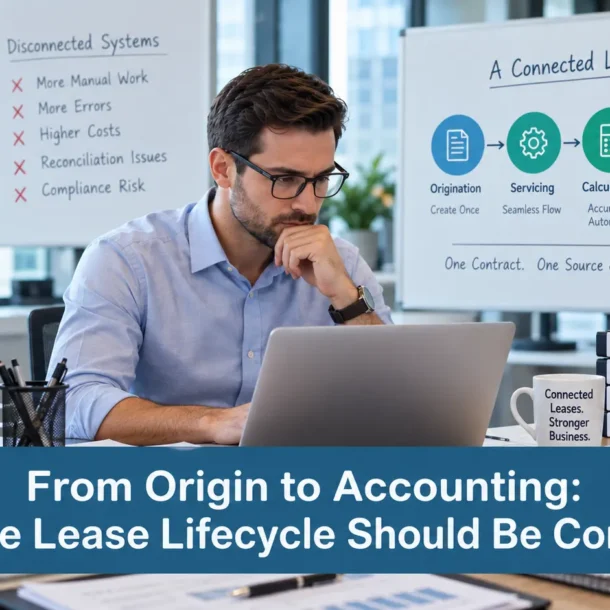
All five mistakes share one root: origination, operations, and accounting are disconnected.
Misclassification happens when sales prices without accounting logic. Wrong rates happen when accounting cannot see origination assumptions. IDC errors happen when costs are not linked to leases. Modifications fail when operations and accounting live in different systems. Residual errors happen when asset management lives in Excel and accounting in ERP.
You cannot fix this with more checklists and spreadsheets. You fix it by connecting the lifecycle.
A connected platform ensures the rate, classification, IDC, residual, and payment schedule sales agreed to is exactly what accounting books, what operations bills, and what gets remeasured. One data model, one calculation engine, one audit trail from quote to retirement.
Lessors who connect close faster, pass audits cleaner, and understand which leases truly drive profitability and long-term portfolio growth every quarter.
These improvements reduce manual effort, shorten month-end close cycles, improve forecast accuracy, and give leadership visibility into true economic performance across the entire lease portfolio consistently. Connected data eliminates reconciliation and empowers confident decisions today.

Reach our dedicated support team
at info@athenafintech.com or +1 650 701 7703.
Questions or assistance?
We’ve got you covered.
Athena Fintech Inc.
HQ: California, USA
Tech Center: India
Athena Fintech Inc.
HQ: California, USA
Tech Center: India