

CFOs today face increasing pressure to improve financial accuracy, strengthen controls, reduce operational costs, and provide timely information for decision-making. Lease accounting software has become an important part of that responsibility as organizations manage larger portfolios, more complex agreements, and growing reporting requirements.
Modern lease accounting software should do more than calculate monthly payments. CFOs should expect a connected environment that brings contract information, accounting rules, billing, amortization, transactions, reporting, controls, and workflow automation together. The right technology can reduce manual work while giving finance leaders greater visibility into the financial impact of leases.
Lease accounting has evolved from a largely administrative process into an important component of financial operations. A lease may contain payment schedules, commencement dates, renewal options, purchase options, incentives, maintenance responsibilities, asset information, and other terms that can affect accounting treatment.
For CFOs, the issue is not simply how quickly an accounting team can enter data. The larger question is whether the organization has a reliable process for maintaining lease information throughout the contract lifecycle.
A modern platform should help create that reliability.
One of the first things CFOs should expect is centralized and structured lease data. Contract information should not remain isolated in documents or individual spreadsheets.
A modern system should provide a consistent record for customers, vendors, contracts, assets, payment schedules, and related financial information. Centralization can make information easier to find and reduce duplicate data entry.
Structured data also provides a foundation for automation. When important contract terms are stored in defined fields, the system can use that information for billing, amortization, accounting entries, reporting, and other downstream activities.
For finance leaders, this creates a clearer connection between source information and financial results.
CFOs should expect software to reduce repetitive manual activities. Lease accounting often involves recurring calculations, billing activities, journal entries, reconciliations, and reporting.
Automation can help standardize these processes and reduce the need for employees to repeatedly move information between files or applications.
For example, once a contract is established, a connected system can use its terms to support payment schedules, amortization calculations, billing, and accounting transactions. Automated workflows can also route activities for review or approval when required.
The goal is not automation for its own sake. The goal is to reduce unnecessary administrative effort while maintaining appropriate controls.
Modern lease accounting software should provide reliable calculations based on configured accounting rules and contract information. Depending on the portfolio and accounting requirements, calculations may include lease liabilities, right-of-use assets, interest, amortization, payment schedules, and related accounting entries.
For CFOs, calculation accuracy is essential because errors can affect financial statements and management reporting.
Software should also make calculation results understandable and traceable. Finance professionals should be able to review relevant inputs, schedules, transactions, and accounting outputs rather than relying on an unexplained result.
Organizations applying U.S. GAAP need processes that support ASC 842 lease accounting requirements. Organizations operating internationally may also need to address IFRS 16 or other applicable accounting frameworks.
CFOs should evaluate whether a solution supports the accounting requirements relevant to their organization and whether those requirements can be maintained as policies or contracts change.
Software does not replace accounting judgment. Instead, it should provide tools that help finance teams apply established accounting policies consistently and document the information supporting their calculations and decisions.
A CFO needs more than individual contract details. Finance leaders need portfolio-level visibility.
Modern software should make it easier to understand an organization’s lease obligations, payment activity, contract status, asset information, and accounting results. Dashboards and reports can help identify trends, exceptions, upcoming expirations, outstanding items, and other information requiring attention.
This visibility can support financial planning and operational decision-making. It can also reduce the time employees spend manually combining information from multiple spreadsheets.
Financial software must provide more than convenience. It should support internal controls.
CFOs should expect features such as role-based access, approval workflows, audit trails, validation controls, and clear records of changes. These capabilities can help organizations establish accountability over financial data and processes.
Auditability is especially important when lease information changes. A system should help users understand what changed, when it changed, and which process or user was involved, based on the organization’s configuration and permissions.
Effective controls can reduce operational risk while making review processes more consistent.
Lease accounting should not operate as a disconnected activity. Modern software should connect lease information with related financial operations where appropriate.
Depending on the organization, this may include billing, accounts receivable, cash receipts, general ledger processes, reporting, payment systems, tax services, or other business applications.
Integration can reduce duplicate entry and improve consistency between operational and accounting records. It can also help finance teams create a more complete view of financial activity.
CFOs should ask how a prospective system exchanges data with existing applications and whether those integrations can support future growth.
Lease portfolios rarely remain static. Organizations may add contracts, acquire businesses, change vendors, purchase equipment, expand locations, or enter new markets.
Scalability includes more than database capacity. It also means that workflows, reporting, permissions, integrations, and controls can continue to operate effectively as the organization grows.
A solution that works for a small portfolio but becomes difficult to manage at higher volumes may create new operational challenges.
Sophisticated technology should still be understandable to the people using it.
CFOs should look for systems that provide clear workflows and intuitive screens. Users should be able to find contracts, review schedules, process transactions, generate reports, and complete assigned tasks without unnecessary complexity.
Ease of use can affect adoption, training requirements, and productivity. A technically powerful platform may provide limited value if employees struggle to use it consistently.
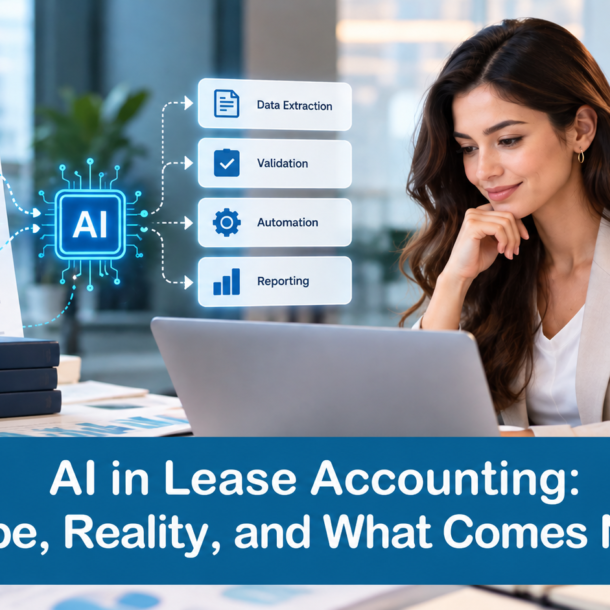
Artificial intelligence is becoming an emerging capability in lease accounting. AI can support activities such as extracting information from contracts, identifying missing data, recognizing potential inconsistencies, and helping users find information through natural-language questions.
The most useful AI capabilities are those that reduce repetitive work while fitting into established financial workflows.
CFOs increasingly need timely information rather than reports assembled manually at the end of a process.
Modern lease accounting software should provide reporting that helps finance teams understand portfolio activity and financial results. Depending on the organization’s needs, reports may cover contracts, payments, amortization, transactions, balances, assets, and exceptions.
When reporting is connected directly to structured system data, finance teams may spend less time preparing information and more time interpreting it.
When evaluating modern lease accounting software, CFOs should consider several practical questions.
When evaluating modern lease accounting software, CFOs should consider several practical questions.
Does the system centralize contract and financial data?
Can it automate repetitive accounting and operational processes?
Does it support the organization’s accounting requirements?
Are calculations transparent and reviewable?
Does it provide strong controls and auditability?
Can it integrate with existing financial systems?
Does it provide useful portfolio reporting?
Can it manage increasing contract volumes?
Is it easy for accounting teams to use?
Can AI capabilities be applied with appropriate oversight?
These questions can help organizations evaluate technology based on business requirements rather than marketing terminology.
The future of lease accounting will likely involve greater automation, stronger integration, intelligent document processing, natural-language interaction, and more proactive exception management.
However, technology will not remove the need for accounting expertise. Financial teams will continue to establish policies, review complex transactions, assess exceptions, maintain controls, and make professional judgments.
For CFOs, the opportunity is to create an operating model where technology handles repeatable activities and finance professionals concentrate on analysis, oversight, and decision-making.
Modern lease accounting software should provide more than a digital replacement for spreadsheets. It should create a controlled and connected environment for managing lease information and financial processes.
For CFOs, the value can be measured through several outcomes: better data quality, fewer manual processes, stronger controls, improved visibility, more efficient reporting, and greater confidence in financial information.
The right platform should support the organization today while providing a foundation for future growth. As lease portfolios become more complex and financial teams face increasing expectations, technology can help connect contract data, accounting processes, operational workflows, and reporting.
Ultimately, CFOs should expect lease accounting software to make financial operations more organized, transparent, and efficient. AI and automation can enhance that foundation, but reliable data, accounting logic, controls, and human oversight remain essential. The goal is not simply to adopt modern technology. It is to build a lease accounting process that gives finance leaders dependable information, stronger operational control, and more time to focus on the decisions that matter most.

Reach our dedicated support team
at info@athenafintech.com or +1 650 701 7703.
Questions or assistance?
We’ve got you covered.

Athena Fintech Inc.
HQ: California, USA
Tech Center: India
Athena Fintech Inc.
HQ: California, USA
Tech Center: India